
100 Random Objects to Draw: Ultimate Creative Prompt List


A Pokémon generator is a free online tool that uses a random number generation (RNG) algorithm to pick one or more random Pokémon from all 1,025+ species across Generations 1 through 9 instantly.
Instead of manually scrolling through the National Pokédex, the tool pulls unbiased results in milliseconds. Players use it for self-imposed gaming challenges, casual battles, team drafting, and artistic drawing exercises.
Whether you want a single creature or a complete team of six, modern web tools give you full control over generations, elemental types, and special legendary filters.
A Pokémon generator is a software program that selects random pocket monsters from an underlying database based on your chosen settings.
Over 1,025 official Pokémon exist today across nine distinct generations. Trying to choose a team fairly without personal bias is nearly impossible for human players.
A dedicated random Pokémon picker solves this problem by handling the math for you. You click a single button, and the system delivers an unexpected Pokémon along with its types, region, and official artwork.
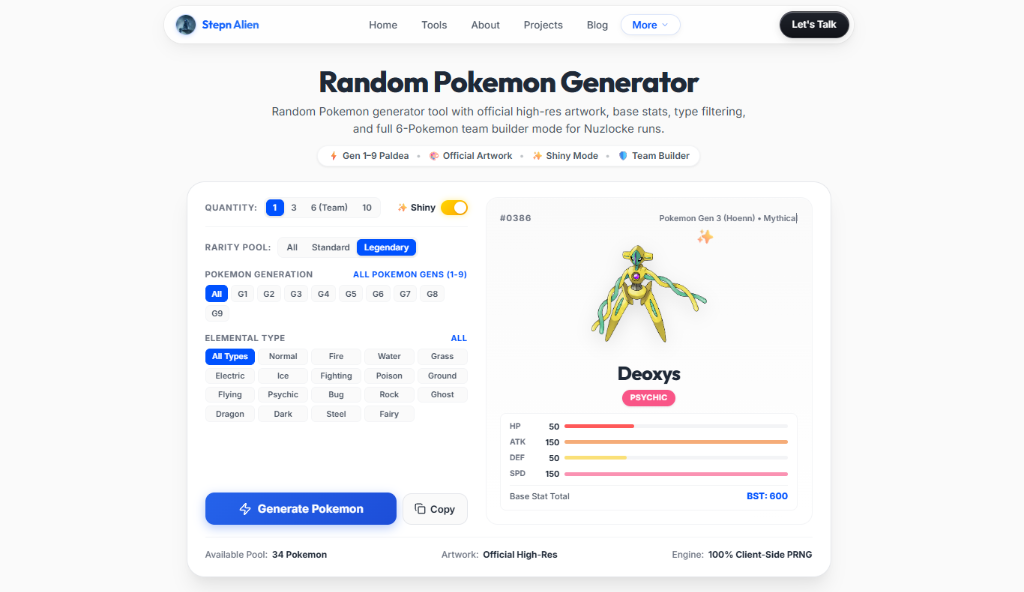
Random Pokémon Generator interface with generation filters, shiny mode, and base stats
Modern web generators work by pairing a complete Pokémon database with a fast randomization algorithm. When you tap generate, the browser executes a lightweight script that completes three quick steps.
First, the script filters the master database to keep only the species matching your rules. If you select Generation 1 and Fire types, it narrows the pool to eligible monsters like Charizard, Arcanine, and Magmar.
Second, the system creates a cryptographic random number. High-quality tools use the browser's built-in Web Cryptography API (crypto.getRandomValues) rather than predictable math formulas.
Third, the tool maps that random number to an exact index in the filtered array. The selected monster appears instantly on your screen with zero page reloads or server delays.
| Generation | Region | Notable Starters & Mascots | National Dex Range |
|---|---|---|---|
| Generation 1 | Kanto | Bulbasaur, Charmander, Squirtle, Pikachu | #0001 – #0151 |
| Generation 2 | Johto | Chikorita, Cyndaquil, Totodile, Lugia | #0152 – #0251 |
| Generation 3 | Hoenn | Treecko, Torchic, Mudkip, Rayquaza | #0252 – #0386 |
| Generation 4 | Sinnoh | Turtwig, Chimchar, Piplup, Arceus | #0387 – #0493 |
| Generation 5 | Unova | Snivy, Tepig, Oshawott, Victini | #0494 – #0649 |
| Generation 6 | Kalos | Chespin, Fennekin, Froakie, Greninja | #0650 – #0721 |
| Generation 7 | Alola | Rowlet, Litten, Popplio, Mimikyu | #0722 – #0809 |
| Generation 8 | Galar | Grookey, Scorbunny, Sobble, Zacian | #0810 – #0905 |
| Generation 9 | Paldea | Sprigatito, Fuecoco, Quaxly, Koraidon | #0906 – #1025 |
RNG stands for Random Number Generation. In video games, RNG decides whether an attack lands a critical hit, whether a wild monster appears, or whether a Poké Ball catches its target.
In an online random Pokémon maker, RNG ensures that every single creature has the exact same probability of appearing. Poorly coded tools use basic pseudo-random functions that frequently favor certain database entries over others.
When you use our client-side generator Pokémon tool, rejection sampling eliminates statistical bias. Every roll gives you an authentic, unpredictable surprise just like opening a fresh booster pack.
Trainers use random generators for several popular gameplay activities that keep the franchise fresh after hundreds of hours.
The most famous use case is the Nuzlocke challenge run. Instead of picking the strongest starter, players roll a random Pokémon to determine their companion and route encounters.
Competitive players also use random pickers for draft tournaments with friends. Each trainer receives six randomized creatures and must build a winning battle strategy around unexpected team synergies.
Artists and animators love drawing prompts generated by randomizers. Rolling a random creature tests your ability to sketch diverse creature anatomies, textures, and dynamic poses outside your comfort zone.
Yes, advanced generators let you apply precise filters so you only roll creatures suitable for your specific game version or challenge rules.
If you are playing *Pokémon HeartGold* on the Nintendo DS, you can limit results strictly to Generation 1 and Generation 2. This prevents late-game monsters from spoiling your retro playthrough.
You can also filter by elemental types like Water, Ghost, Dragon, or Steel. This feature is essential for "Gym Leader" themed challenge runs where you must conquer the game using only one primary type.
If you want an even wilder challenge, you can enable or disable legendary, mythical, and ultra-beast categories with a single toggle.
A Nuzlocke challenge is a set of self-imposed community rules designed to make Pokémon games significantly harder. The core rules state that if a monster faints it is considered dead, and you may only catch the first creature on each route.
Many modern players play an enhanced version called a "Randomlocke." In this format, you consult a random generator Pokémon tool whenever you enter a new route.
Whatever monster the tool generates becomes your target catch for that area. This forces you to battle with underrated Pokémon like Dunsparce, Maractus, or Pachirisu rather than relying on standard powerhouse options.
It turns every gym battle into an intense tactical puzzle where careful item management and type advantages truly matter.
Building a functioning team out of completely random rolls is one of the most rewarding exercises in the Pokémon hobby.
When you generate a batch of six creatures using a random Pokémon team generator, check their collective defensive weaknesses first. A team with three Rock types will struggle heavily against common Water and Grass attacks.
Next, look at their offensive coverage. Ensure you have physical attackers for high Special Defense walls, and special attackers for high physical Defense tanks.
Finally, review support moves like stealth rocks, status conditions, and speed control. You will quickly discover that many overlooked species have incredible utility moves that turn the tide of difficult battles.
Not all generator tools on the internet are created equal. Many older websites suffer from intrusive full-screen ads, slow loading speeds, and outdated lists that stop at Generation 6.
A top-tier Pokémon random tool should provide:
Generate custom Pokémon teams across all 9 generations with type filters, shiny chances, and instant stat cards.
Try it free →A complete generator includes 1,025 official species spanning from Bulbasaur (#0001) in Generation 1 all the way to Pecharunt (#1025) in Generation 9.
Our random Pokémon generator uses cryptographic randomness via the Web Cryptography API. Pikachu, Charizard, and Eevee have the exact same mathematical probability of appearing as less famous species like Finneon or Binacle.
Yes. You can switch the quantity selector to generate up to 6 Pokémon simultaneously. The tool ensures no duplicate species appear in the same batch so your battle team remains tournament-legal.
Yes. Advanced pickers feature a dedicated shiny toggle or an authentic 1-in-4,096 probability roll to surprise you with rare alternate color palettes during your team generation.
Absolutely. Many battle communities use random generators to pick draft tiers, and then recreate those exact teams in Pokémon Showdown to compete in casual battle tournaments.